Conductive yarn is an ordinary-looking textile yarn with one extraordinary property: it conducts electricity. This apparently simple addition - making a textile material electrically conductive - opens up a range of applications that were technically impossible with conventional yarn: garments that monitor vital signs, heating elements woven into fabric, antistatic workwear that prevents charge buildup, textiles that transmit data signals, and interactive surfaces that respond to touch. As the electronics industry looks for ways to integrate functionality into the form factor of clothing and soft goods, conductive yarn is the fundamental enabling material that makes the textile-electronic interface possible.
Understanding the different types of conductive yarn, what their electrical properties actually are, how those properties are measured and specified, and what determines performance in specific applications is essential for anyone sourcing conductive yarn for functional textile development.
Carbon Conductive Yarn
Carbon fiber or carbon-loaded polymer fiber yarn provides moderate electrical conductivity - higher resistance than metal-based constructions but with specific advantages: excellent thermal stability, good chemical resistance, and lighter weight per unit length than metal-containing constructions. Carbon-based conductive yarn is used in heating applications where the resistive heating is evenly distributed through the textile, in high-temperature environments where metal-based constructions would oxidize, and in applications where the electromagnetic signature of the yarn matters (carbon reflects radar at different frequencies than metallic materials, which is relevant for certain defense applications).
Stainless Steel Fiber Yarn
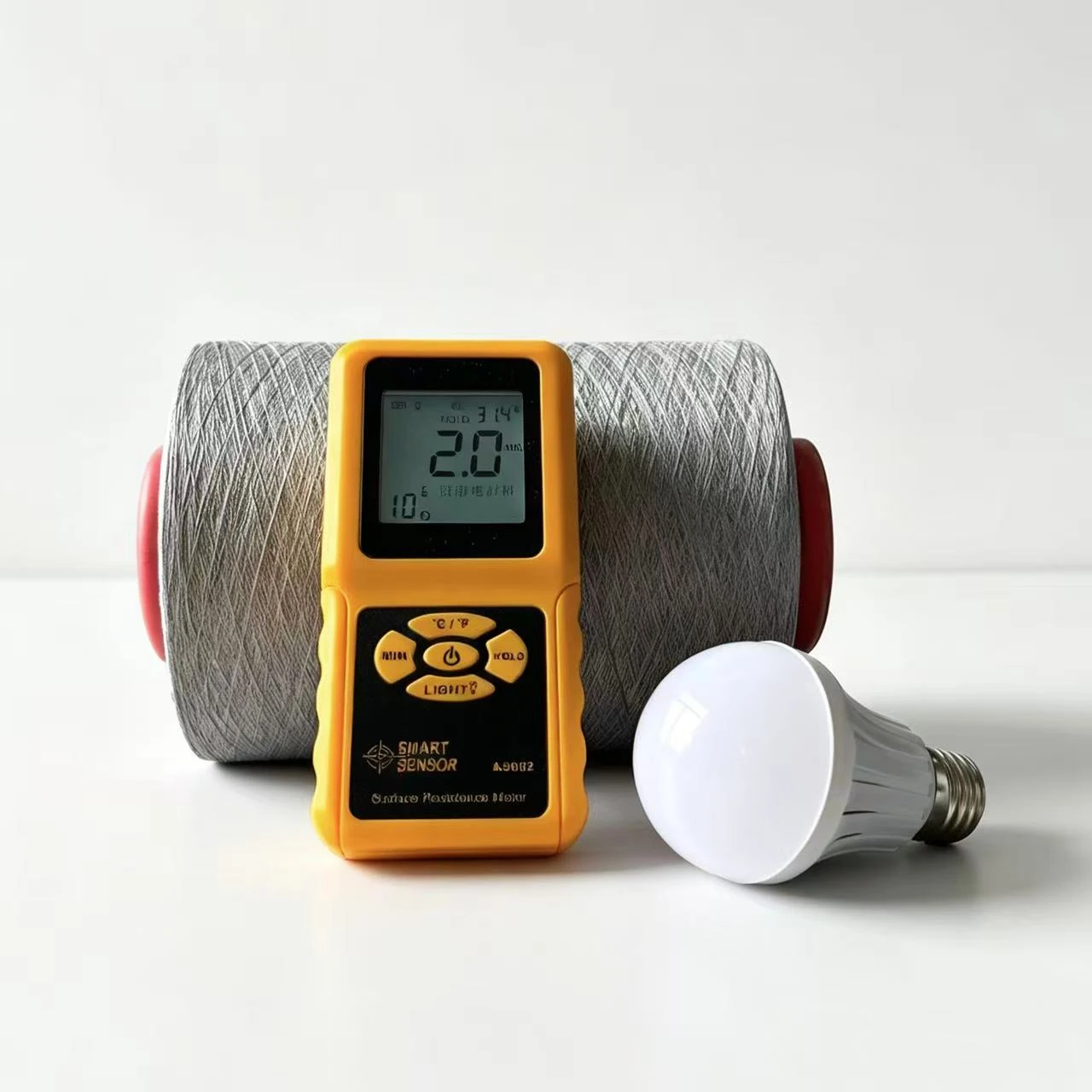
Stainless steel fiber conductive yarn blends or wraps fine-diameter stainless steel filaments (typically 4–22 µm diameter, sometimes as fine as 1–3 µm) with standard textile fibers. The stainless steel fibers form a distributed conductive network through the yarn cross-section, providing both mechanical continuity and electrical connectivity. The resistance of stainless steel fiber yarn is higher than silver or copper-based constructions (stainless steel's electrical resistivity is approximately 7 × 10⁻⁷ Ω·m, versus 1.6 × 10⁻⁸ Ω·m for copper), but its physical properties - washability, abrasion resistance, compatibility with standard textile processing, and no corrosion under ambient conditions - make it one of the most practically used conductive yarn types in commercial applications.
Stainless steel fiber yarn is the standard specification for antistatic textiles in electronics manufacturing environments, chemical processing, and other industries where electrostatic discharge (ESD) is a safety or quality risk. The yarn's resistance is low enough to provide a discharge path for static charges without being low enough to create electrical safety hazards. It's also used in electromagnetic shielding fabrics, pressure-sensing textiles, and heating elements in textile form where resistance heating is required.
Silver-Coated Yarn
Silver-coated conductive yarn applies a continuous metallic silver coating to the surface of base fibers - typically nylon or polyester filament yarn - through electroless plating or physical vapor deposition. Silver's extremely high electrical conductivity (the highest of any metal at room temperature) produces yarn with very low resistance per unit length - typically 100–500 Ω/m for commercial silver-coated yarn, compared to 1,000–10,000 Ω/m or more for stainless steel blends. This low resistance per unit length makes silver-coated yarn the preferred choice for applications requiring efficient signal transmission, low-resistance electrical pathways in wearable electronics, and electromagnetic shielding where high shielding effectiveness requires low surface resistance.
The primary limitation of silver-coated yarn is durability: the silver coating, while well-adhered in modern plated constructions, can develop resistance increase with repeated flexion and laundering as the coating develops micro-cracks and oxidizes. The initial resistance of high-quality silver-coated yarn is excellent; the stability of that resistance through a garment's service life - including multiple wash cycles, ironing, and sustained mechanical flexion - is more variable and depends on the coating thickness, adhesion chemistry, and the mechanical demands of the end use. For applications where long-term resistance stability is critical (implantable electronics, medical monitoring garments), the wash and wear durability of the silver coating must be characterized rather than assumed from initial resistance measurements.
Copper-Based Conductive Yarn
Copper has slightly higher electrical conductivity than silver per unit volume and significantly lower cost. Copper-based conductive yarn is used where very low resistance is required, and cost is a constraint - signal bussing in wearable electronics, resistive heating elements in electric heated garments, and electrical connectors integrated into textile structures. Copper oxidizes readily in ambient air, which progressively increases surface resistance and creates reliability concerns in long-term applications; copper-based yarn is often tinned (tin-coated) or silver-plated to address this, which adds cost and partially offsets the material cost advantage over silver-coated alternatives.