Antistatic yarns are broadly classified into four main types: conductive
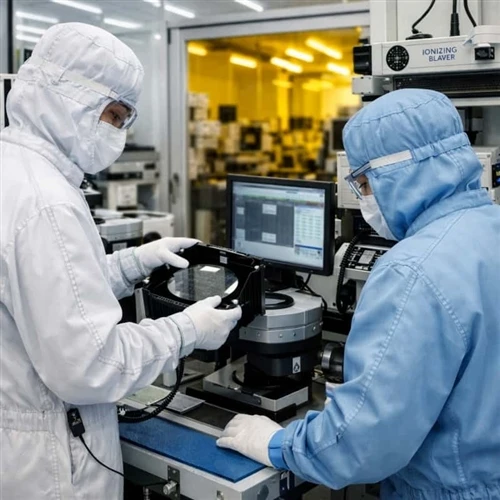
fiber-blended yarns, carbon black-core yarns, metal fiber composite yarns, and surface-treated yarns. Each type achieves static dissipation through a different mechanism, and the right choice depends on the required surface resistivity, end-use environment, wash durability, and comfort requirements. Understanding these categories helps manufacturers and buyers select the most suitable solution for applications ranging from cleanroom workwear to industrial conveyor belts.
Conductive Fiber-Blended Yarns
Conductive fiber-blended yarns are produced by incorporating a small percentage of inherently conductive fibers-typically 2–4% by weight-into a base fiber such as polyester or nylon. The conductive component forms a continuous network throughout the yarn cross-section, allowing charge to dissipate along the fiber length before buildup occurs.

China Anti-Static Yarn 70D , Gray Color Manufacturers, Suppliers and Factory - Taierxin
How the conductive network forms
When conductive fibers are distributed at sufficient density, they create percolation pathways. Electrons move along these paths rather than accumulating on the surface. A well-designed blend typically achieves a surface resistivity in the range of 10⁶ to 10⁹ Ω/sq, which meets ESD (electrostatic discharge) protection requirements for most industrial environments.
Carbon Black-Core (Bi-Component) Yarns
Carbon black-core yarns, also called bi-component or sheath-core antistatic yarns, have a structure where a carbon black-loaded polymer core is encased in a standard polymer sheath. The conductive core carries charge away while the outer sheath provides the desired textile hand-feel, dyeability, and appearance.

China Nylon Conductive Fibers N96-20D-3F Manufacturers, Suppliers and Factory - Taierxin
Structure and performance
The core typically contains 15–30% carbon black by weight of the core polymer, which is sufficient to cross the percolation threshold and deliver consistent conductivity. The resulting fiber volume resistivity usually falls between 10² and 10⁵ Ω·cm, making it one of the most electrically conductive yarn types available.
Because conductivity is built into the fiber structure rather than applied as a coating, performance is permanent and unaffected by washing or abrasion. This makes carbon black-core yarns a preferred option for long-life industrial fabrics, conveyor belts, filter media, and floor coverings in electronics manufacturing facilities.
Limitations
The main drawback is color-carbon black imparts a gray or black appearance, limiting use in light-colored or fashion-oriented textiles. The sheath partially mitigates this, but the yarn is still most commonly seen in dark-toned technical fabrics.
Metal Fiber Composite Yarns
Metal fiber composite yarns incorporate drawn metal filaments-most commonly stainless steel (316L grade) or copper alloy-either as individual strands twisted with textile fibers or as a wrapped construction. The metal content can range from as low as 1% to over 30% depending on the target conductivity level.

Construction methods
Intimate blend: Metal fibers are cut to staple length and blended with natural or synthetic staple during carding or spinning. Produces uniform charge dissipation.
Plied construction: One or more metal filament ends are plied together with conventional textile yarn. Simpler to produce but slightly less uniform antistatic performance.
Wrapped (covered) yarn: A continuous metal filament is helically wrapped around a textile core yarn. Offers a good balance of conductivity, flexibility, and comfort.
Metal fiber composite yarns achieve the lowest resistivity values among all antistatic yarn types-surface resistivity can reach below 10⁴ Ω/sq-making them suitable for high-risk ESD zones such as explosive atmospheres and semiconductor fabrication areas (classified as ATEX Zone 0/1 environments).
Stainless steel fiber diameters used in textiles typically range from 6–12 µm, approaching the fineness of natural silk, which allows for soft and flexible yarns despite the metal content.
Surface-Treated Antistatic Yarns
Surface-treated antistatic yarns are conventional textile yarns-polyester, nylon, acrylic-that receive a conductive coating or chemical finish applied to the fiber or yarn surface. Common treatment types include:
Hygroscopic finish: Increases moisture absorption on the fiber surface, improving ion mobility and charge dissipation. Works best at relative humidity above 40%.
Conductive polymer coating: Polythiophene, polyaniline, or PEDOT:PSS is deposited onto the yarn. Achieves surface resistivity of 10⁶–10⁸ Ω/sq.
Metal plating (electroless): A thin layer of silver, nickel, or copper is chemically deposited onto the fiber surface, delivering high conductivity (10²–10⁴ Ω/sq) and additional electromagnetic shielding.
Durability considerations
Surface treatments are inherently less durable than structural approaches. Hygroscopic finishes typically degrade after 5–20 wash cycles, whereas electroless metal platings can survive 30–50 wash cycles if protected by a top coat. These yarns are best suited for disposable or short-life applications such as single-use packaging, temporary anti-static matting, or cost-sensitive apparel.
|
Table 1: Key performance and suitability comparison of antistatic yarn types |
||||
|
Yarn Type |
Surface Resistivity (Ω/sq) |
Wash Durability |
Color Flexibility |
Typical Applications |
|
Conductive fiber blend |
10⁶ – 10⁹ |
High (50–100 cycles) |
Good |
Cleanroom garments, ESD workwear |
|
Carbon black-core |
10² – 10⁵ |
Permanent |
Limited (dark tones) |
Conveyor belts, floor coverings, filters |
|
Metal fiber composite |
< 10⁴ |
Permanent |
Moderate |
ATEX workwear, semiconductor fab, EMI shielding |
|
Surface-treated |
10² – 10⁸ |
Low (5–50 cycles) |
Excellent |
Packaging, disposable items, fashion |